Towel Supplier Selection
How to Choose a Towel Supplier for Wholesale and Private Label Orders
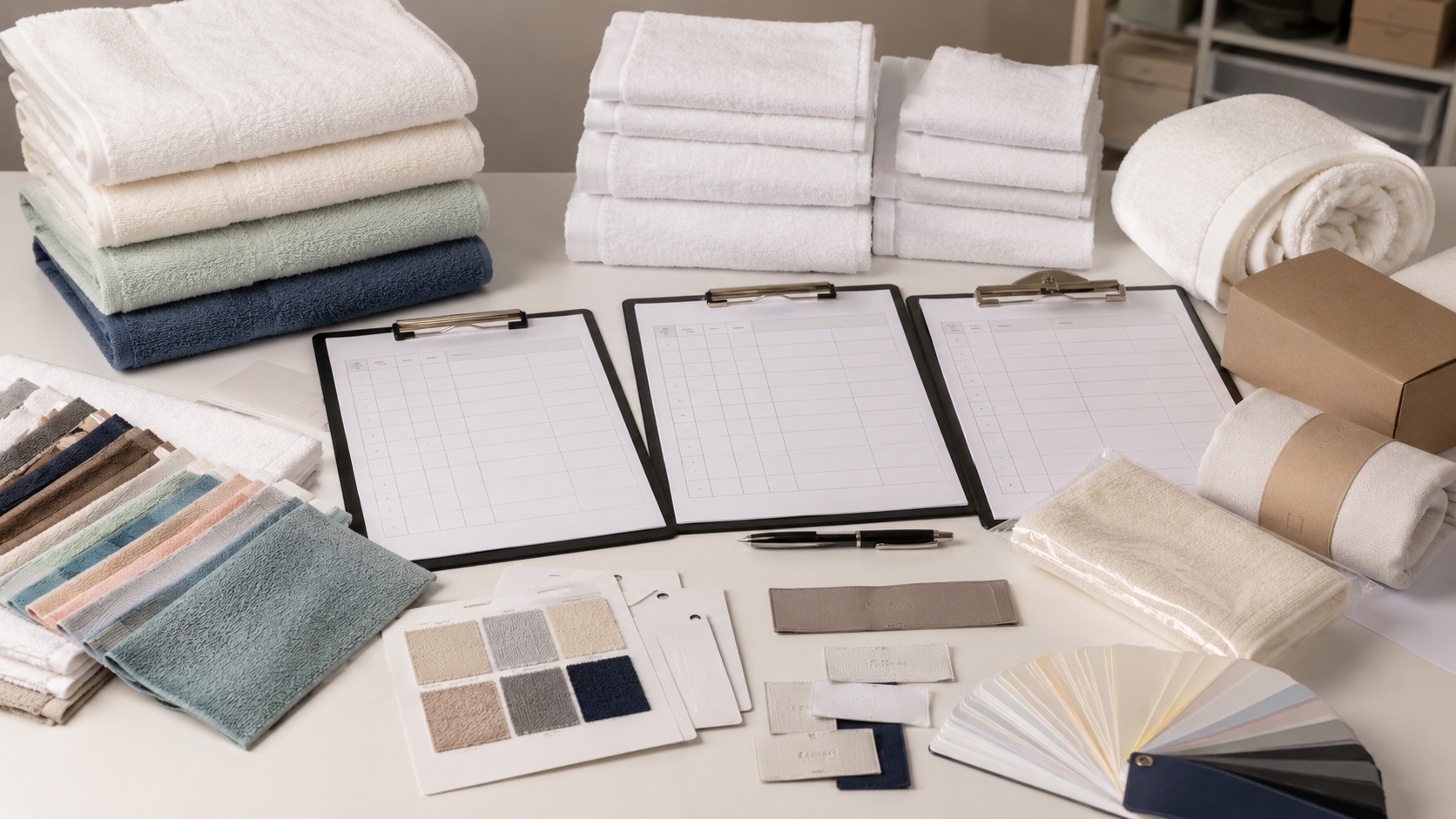
A towel supplier should help buyers clarify specification, sample approval, packaging, quality checks, and quotation assumptions. The lowest unit price is not useful if the quote excludes labels, packaging, carton marks, or a realistic GSM.
Towel supplier selection should test whether the supplier can clarify specifications, samples, packaging, quality checks, and quotation assumptions.
Choosing a towel supplier is not only about finding the lowest unit price. Wholesale and private label towel buyers need a supplier who can understand specifications, discuss material and GSM, prepare samples, support labels and packaging, check quality, and communicate clearly before bulk production.
| Decision point | What the buyer should confirm | Why it matters |
|---|---|---|
| Product fit | Does the supplier understand bath towels, hotel towels, logo towels, towel sets, or private label towels? | Product fit reduces back-and-forth and improves sample accuracy. |
| Quotation clarity | What is included: towel base, logo, label, packaging, sample, carton mark, and quantity per color? | Clear quote scope prevents false price comparison. |
| Communication quality | Can the supplier explain tradeoffs and open questions? | Good sourcing support helps buyers avoid incomplete specifications. |
| Inspection approach | Which size, weight, stitching, color, label, packaging, and carton checks are included? | Inspection points should match the buyer's selling channel and risk level. |

Use the page as a practical scorecard for towel supplier risk.
- Send the same RFQ to every supplier and require size, GSM, material, logo, packaging, and sample assumptions.
- Look for useful clarification questions; weak replies often quote price without defining the product.
- Shortlist suppliers by sample handling, packaging understanding, quality checks, and repeat-order communication.
A supplier scorecard does not need to be complicated. It should show who understood the RFQ, who asked useful questions, who could support logo and packaging, who explained quality checks, and who gave a quote with clear assumptions.
A useful supplier comparison looks at capability, product fit, customization support, sample process, quality control, packaging experience, and quotation transparency. If different suppliers quote different specifications, the comparison is not reliable.
A good towel supplier does not only answer questions; they help uncover the missing ones. If a buyer sends a short message asking for bath towel price, a stronger supplier will usually ask about size, GSM, material, color, logo, packaging, quantity, sample goal, and destination market before treating the quote as final.
Check product range and category fit
Start with whether the supplier works with the towel category you need: bath towels, hand towels, face towels, hotel towels, baby towels, beach towels, yoga towels, sport towels, promotional towels, or towel sets. A supplier may be strong in one category but less practical for another.
Ask how the supplier handles specifications
A serious towel supplier should ask for towel type, size, GSM, material, color, logo method, label, packaging, quantity, destination market, and sample needs. If the supplier gives a price without asking these details, the quote may be based on assumptions.
Review private label support
Private label towels may require woven labels, wash labels, hang tags, embroidery, paper bands, zipper bags, gift boxes, insert cards, barcode labels, and carton marks. Ask which parts can be supported and what artwork or files are needed before sampling.
Compare sample communication
Samples should answer specific questions. Are you testing hand feel, GSM, color, logo, packaging, or full product presentation? A good supplier should help define what the sample is meant to confirm and explain which details may need adjustment after review.
Sample communication is a useful test because it shows how the supplier handles uncertainty. A clear supplier explains what the sample will prove, what is still different from bulk production, and which approval points should be written down. A weak supplier may send a sample without clarifying what the buyer is supposed to judge.
Check quality and shipment process
Before placing bulk orders, ask how size, weight, stitching, color, labels, packing quantity, and carton marks are checked. If third-party inspection or special documentation is required, raise it early. For certification-related needs, confirm the exact standard, certificate scope, and product applicability before making claims.
Use consistent comparison fields
To compare suppliers fairly, send the same RFQ to each one. Include size, GSM, material, color, logo, packaging, quantity, and sample requirements. Then compare not only price but also communication quality, clarity of assumptions, sample plan, and ability to explain tradeoffs.
Red flags in supplier replies
A weak supplier reply often avoids specification details. Watch for answers that quote only a unit price without size, GSM, material, packaging, or logo assumptions. Also be careful when a supplier says every option is possible but does not ask for artwork, label files, color reference, packing method, or sample approval points.
A stronger reply usually includes clarifying questions. The supplier may ask whether the towel is for hotel, retail, gym, spa, ecommerce, promotion, or private label use; whether the buyer needs sample development or quotation only; and whether packaging should include paper band, zipper bag, box, carton mark, or barcode. Those questions show whether the supplier understands the real order path.
Score towel suppliers by sourcing risk, not only price
A buyer can turn this guide into a supplier scorecard. Give every supplier the same RFQ, then score whether they ask useful clarification questions, explain quotation assumptions, understand logo and packaging requirements, and can support sample review and quality checks.
This is more practical than asking, “Are you a good factory?” A supplier that helps define size, GSM, material, label, packaging, and inspection points usually gives the buyer a clearer path from sample to repeat order.
Towel supplier shortlist evidence
Before shortlisting a supplier, keep the quote basis, sample plan, communication notes, packaging understanding, inspection plan, and open risks. If two suppliers quote different assumptions, adjust the RFQ before comparing price.
If a supplier reply feels too thin, ask for the quotation basis before eliminating or selecting them. Sometimes the issue is not capability but an incomplete RFQ; sometimes the vague answer reveals a real communication risk.
- Ask for quotation assumptions, not only unit price.
- Send the same RFQ to each supplier before comparing.
- Check whether the supplier can discuss logo, labels, and packaging before sampling.
- Ask what the sample will confirm and how final approval is recorded.
- Review whether the supplier's product focus matches your towel category.
- Do not select a supplier based only on the first low price.
- Do not let the supplier quote an unspecified towel and compare it with a full RFQ.
- Do not delay packaging discussion until after price negotiation.
FAQ
What is the first thing to ask a towel supplier?
Ask whether they can work with your towel type, size, GSM, material, logo, packaging, quantity, and target market.
Should I choose the cheapest towel supplier?
Not by price alone. Compare the actual specification, sample quality, packaging, communication, and quality checks.
What makes a private label towel supplier practical?
A practical supplier can discuss labels, logos, packaging, artwork, samples, carton marks, and quality checks before bulk production.
How can I compare multiple suppliers fairly?
Send the same specification and packaging requirements to each supplier, then compare quote assumptions and sample results.